
There is a phrase in Italian – la dolce vita – that translates roughly as “the sweet life,” and it captures something essential about why Italy has been drawing travelers from across the globe for centuries. Italy is not simply a destination. It is a way of experiencing the world: slowly, passionately, with full attention to beauty, food, history, and human connection.
With more UNESCO World Heritage Sites than any other country on Earth, Italy is the undisputed capital of civilization’s greatest achievements. It is the country that gave the world the Colosseum and the Roman Forum, the Sistine Chapel and St. Peter’s Basilica, Michelangelo’s David and Botticelli’s Birth of Venus, the canals of Venice and the Leaning Tower of Pisa. It is the birthplace of the Renaissance, the origin of opera, and the home of the world’s most beloved cuisine.
For travelers from the USA – especially Indian families and NRI visitors planning their first European adventure – Italy consistently ranks as one of the most fulfilling and emotionally resonant destinations they will ever visit. The combination of ancient history, extraordinary art, spectacular landscapes, warm hospitality, and incredible food creates a travel experience that engages every sense and leaves every visitor wanting to return.
This comprehensive guide covers the very best things to do in Italy, from the iconic landmarks of Rome and the artistic treasures of Florence to the romantic canals of Venice and the architectural wonders of Pisa and Milan. It also includes a complete 10-day Italy itinerary, a realistic breakdown of Italy trip costs from USA, essential travel safety tips, the best time to visit, and detailed information on the Italy tour packages offered by Global Holidays USA for families and groups.
Rome: The Eternal City Where Every Stone Tells a Story
Rome is unlike any other city in the world. Walking its streets is a continuous journey through time – you turn a corner and find yourself face to face with a 2,000-year-old temple, a medieval church, a Renaissance fountain, and a Baroque piazza, all within a few hundred meters of each other. Rome’s sheer density of history and art is genuinely overwhelming in the most magnificent way, and every visit reveals something new regardless of how many times you have been before.
Visit the Colosseum: The Greatest Arena in the Ancient World
No monument better represents the ambition, engineering genius, and sheer audacity of the Roman Empire than the Colosseum. Built between 72 and 80 CE under Emperors Vespasian and Titus, this elliptical amphitheater could hold between 50,000 and 80,000 spectators – making it the largest stadium in the ancient world, and a structure that modern architects and engineers still marvel at today.
The Colosseum hosted gladiatorial contests, animal hunts, public executions, and dramatic reenactments of famous battles for nearly four centuries. Walking through its ancient corridors, climbing to its upper tiers, and looking down into the restored hypogeum – the underground network of tunnels and chambers where gladiators and wild animals were held before being raised into the arena – gives you a visceral, almost physical sense of the scale and spectacle of Roman entertainment.
The Global Holidays USA Italy tour packages include a photo stop at the Colosseum, which stands alongside other magnificent nearby sites including the Arch of Constantine and the Roman Forum. Early morning visits offer the best light for photography and noticeably smaller crowds than midday arrivals.
Explore the Vatican: St. Peter’s Basilica and the Heart of the Catholic World
Vatican City is the smallest sovereign state in the world – just 44 hectares within the city of Rome – but its cultural and spiritual significance is immeasurable. For over a billion Catholics worldwide, it is the holiest place on Earth. For art historians and architecture lovers of every faith, it is simply one of the greatest concentrations of human creative achievement ever assembled in a single location.
St. Peter’s Basilica is the architectural centerpiece of the Vatican and one of the most awe-inspiring buildings in human history. Designed primarily by Michelangelo (who created the iconic dome) and completed in 1626 after over 100 years of construction, the basilica’s scale is almost incomprehensible from the inside. The central nave is 220 meters long, and Michelangelo’s extraordinary dome soars 136 meters above the floor. The interior contains an astonishing collection of art and sculpture, including Michelangelo’s Pietà – the marble sculpture of the Virgin Mary holding the body of Christ – which is considered one of the greatest works of sculpture ever created.
St. Peter’s Square, the vast oval piazza in front of the basilica designed by Gian Lorenzo Bernini in the 17th century, is framed by two sweeping colonnades and can hold approximately 300,000 people. On Sunday mornings when the Pope gives his Angelus address, or on major Catholic feast days, the square fills with worshippers and visitors from every country in the world in a gathering of remarkable human diversity and shared purpose.
All Global Holidays USA Italy packages that include Rome feature a guided visit to the Vatican with entrance to St. Peter’s Basilica and St. Peter’s Square, ensuring you experience this extraordinary place with expert commentary and without the logistical challenges of independent booking.
Toss a Coin in the Trevi Fountain
The Trevi Fountain is the most beautiful fountain in Rome and one of the most recognized monuments in the world. Completed in 1762 to a design by Nicola Salvi, it marks the terminal point of one of Rome’s ancient aqueducts – the Aqua Virgo, which has been bringing fresh water into the city since 19 BCE. The fountain’s dramatic baroque composition depicts Neptune, god of the sea, riding a triumphal chariot drawn by two seahorses through a rocky seascape, with water cascading from every surface and filling the large basin below.
The tradition of tossing a coin over your left shoulder into the fountain with your right hand is said to guarantee your return to Rome. It is estimated that approximately €3,000 worth of coins are thrown into the Trevi Fountain every single day – collected nightly and donated to a Roman charity. From February 2026, Rome introduced a small access fee of €2 for tourists who want to enter the close-up viewing area around the fountain during set hours, though the broader piazza view remains freely accessible.
The best time to visit the Trevi Fountain is either very early in the morning before the crowds arrive, or late at night when the fountain is illuminated and the piazza takes on a genuinely magical atmosphere. It appears in the itinerary of every Global Holidays USA Italy tour package as one of Rome’s unmissable landmarks.
The Roman Forum, Pantheon, and Beyond
The Roman Forum, the ancient civic heart of the Roman Empire, stretches between the Palatine and Capitoline Hills directly alongside the Colosseum. Walking through the Forum – past the Temple of Saturn, the Arch of Septimius Severus, the House of the Vestal Virgins, and the ruins of temples, basilicas, and sacred buildings that once formed the center of the known world – is one of the most profoundly moving historical experiences that any city in the world can offer.
The Pantheon, built in its current form by Emperor Hadrian around 125 CE, is the best-preserved ancient building in Rome and is considered the most influential building in Western architecture. Its perfect dome, which features the famous oculus – a 9-meter circular opening to the sky that serves as the only source of light inside the building – was the largest concrete dome in the world for over 1,300 years and directly inspired architectural masterpieces from Michelangelo’s dome at St. Peter’s Basilica to the US Capitol in Washington.
Nearby, the Spanish Steps (Scalinata di Trinità dei Monti) provide a wonderful vantage point over the heart of Rome, and the piazza below is lined with some of the city’s most elegant cafes and fashion boutiques. Piazza Navona, built on the site of an ancient Roman stadium, is one of Rome’s most beautiful and atmospheric squares, centered on Bernini’s magnificent Fountain of the Four Rivers.
Florence: The Birthplace of the Renaissance and Capital of Art
If Rome represents the ancient world at its most magnificent, Florence represents human creativity at its most inspired. This compact, walkable Tuscan city was the epicenter of the Renaissance – that extraordinary flowering of art, science, architecture, literature, and humanism that transformed European civilization between the 14th and 17th centuries – and its historic center remains an almost unaltered masterpiece of 15th and 16th century urban planning and architecture.
Marvel at the Florence Duomo – Brunelleschi’s Engineering Masterpiece
The Duomo of Florence – formally the Cattedrale di Santa Maria del Fiore – is the defining image of the Florentine skyline and one of the most spectacular buildings in the world. Its dome, designed and built by Filippo Brunelleschi between 1420 and 1436, was the largest brick dome ever constructed and remained the largest dome in the world for over five centuries. The achievement was so audacious, using an entirely new double-shell construction technique that Brunelleschi developed specifically for this project, that architects and engineers consider it one of the greatest technical feats in the history of construction.
The exterior of the cathedral is clad in polychrome marble panels in shades of green, pink, and white, creating a visual richness that is almost overwhelming in its beauty. The adjacent Giotto’s Campanile (bell tower) and the octagonal Baptistery of San Giovanni, with its famous gilded bronze doors described by Michelangelo as the Gates of Paradise, complete one of the most extraordinary architectural ensembles in human history.
Piazzale Michelangelo: The Most Breathtaking View of Florence
For the single best panoramic view of Florence, there is no better vantage point than the Piazzale Michelangelo on the hill above the south bank of the Arno River. From this wide, marble-paved terrace, you look out over the entire historic city spread beneath you: the ochre rooftops, the green hills beyond, the silver ribbon of the Arno winding through the center, the Ponte Vecchio spanning the river in the middle distance, and the great dome of the Duomo dominating everything.
Sunset from Piazzale Michelangelo is one of those experiences that travelers consistently describe as one of the most beautiful things they have ever seen. The golden light of the setting sun catches the dome of the Duomo and the terracotta rooftops of the medieval city and turns everything to warm amber and gold. It is included as a key highlight in the Global Holidays USA Italy tour packages, giving travelers a birds-eye introduction to the city.
Walk the Ponte Vecchio and Explore the Historic Center
The Ponte Vecchio is Florence’s most iconic bridge and one of the most recognizable structures in all of Italy. Built in its current form in 1345, it is the oldest bridge in Florence and one of the few bridges in Europe that still has shops built directly on it – a medieval practice that was once common across Europe but has survived here uniquely. Today, the tiny shops on the Ponte Vecchio are exclusively occupied by goldsmiths and jewelers, and the bridge is strung with padlocks left by couples declaring their love.
The Basilica di Santa Croce, located in the piazza of the same name, is Florence’s Franciscan church and the largest Franciscan church in the world. It serves as the burial place of many of the greatest figures of the Italian Renaissance and beyond, including Michelangelo, Galileo Galilei, Niccolò Machiavelli, and composer Gioachino Rossini. Walking through this extraordinary building is an encounter with the greatest minds and artists that humanity has ever produced.
The Piazza della Signoria, Florence’s main civic square, is dominated by the Palazzo Vecchio – the medieval fortress-palace that served as the seat of Florentine government – and the Loggia dei Lanzi, an open-air sculpture gallery featuring original Renaissance masterpieces. A copy of Michelangelo’s David stands at the entrance to the Palazzo Vecchio, while the original is housed in the Galleria dell’Accademia nearby. Both are included in the photo stops on the Global Holidays USA Florence tour.
Venice: The Floating City That Exists Nowhere Else on Earth
Venice is one of those places that seems almost too beautiful and too strange to be real. Built on 118 small islands separated by canals and connected by over 400 bridges in the middle of a shallow Adriatic lagoon, Venice has no cars, no roads in the conventional sense, and no logical reason to exist – and yet it has been one of the most powerful and sophisticated cities in the world for over a thousand years. Even today, when you arrive by train and emerge from Santa Lucia Station to find the Grand Canal spreading before you, your first response is almost inevitably a sharp intake of breath.
Take a Boat Ride to St. Mark’s Square and Basilica
The heart of Venice is the Piazza San Marco – St. Mark’s Square – which Napoleon famously called the “drawing room of Europe.” Arriving by water taxi or vaporetto (water bus) along the Grand Canal and stepping ashore in the square for the first time is one of the great arrival moments in world travel. The square is enclosed on three sides by the Procuratie – the long, arched administrative buildings dating from the 16th century – and dominated on the fourth by the extraordinary Basilica di San Marco.
The Basilica di San Marco is one of the finest examples of Italo-Byzantine architecture in the world. Its five domed roofline, encrusted with golden mosaics, Byzantine carvings, and ancient columns brought from Constantinople and Egypt, creates a building of overwhelming visual richness that seems to belong more to the ancient East than to medieval Italy. The interior is equally extraordinary: every surface is covered in golden mosaics depicting Biblical scenes, creating an effect of shimmering, otherworldly splendor that has been described as the most beautiful church interior in the world.
Ride a Gondola Through Venice’s Ancient Canals
The gondola is Venice’s most iconic symbol and a gondola ride through the city’s narrow, labyrinthine canals is one of the most romantic and memorable travel experiences anywhere in the world. Gliding silently through the medieval backwaters of Venice – under low stone bridges, past peeling palazzo facades, through quiet canals where the only sounds are the dip of the gondolier’s oar and the distant echo of footsteps on flagstones – gives you an entirely different and uniquely intimate perspective on this extraordinary city.
All Global Holidays USA Italy tour packages that include Venice feature a gondola ride with entrance, making this unforgettable experience an included highlight rather than an optional extra. The gondola ride typically passes through some of Venice’s most picturesque small canals before opening out onto a broader waterway with views of major landmarks.
The Bridge of Sighs and the Rialto Bridge
The Bridge of Sighs (Ponte dei Sospiri) is one of Venice’s most photographed and romantically named landmarks. Built in 1600 to link the Doge’s Palace with the New Prison, this ornate white limestone bridge gets its name from the story – probably apocryphal but wonderfully atmospheric – that prisoners would sigh as they caught their last glimpse of beautiful Venice through the bridge’s small, stone-barred windows before descending to their cells.
The Rialto Bridge (Ponte di Rialto) is the oldest and most famous of the four bridges that cross the Grand Canal. Built between 1588 and 1591, it was the only way to cross the Grand Canal on foot for centuries and remains one of Venice’s most iconic images. The bridge is lined with small shops selling jewelry, masks, and souvenirs, and the views of the Grand Canal from its central arch are among the most photographed in the world.
Pisa: The Field of Miracles and the World’s Most Famous Tilt
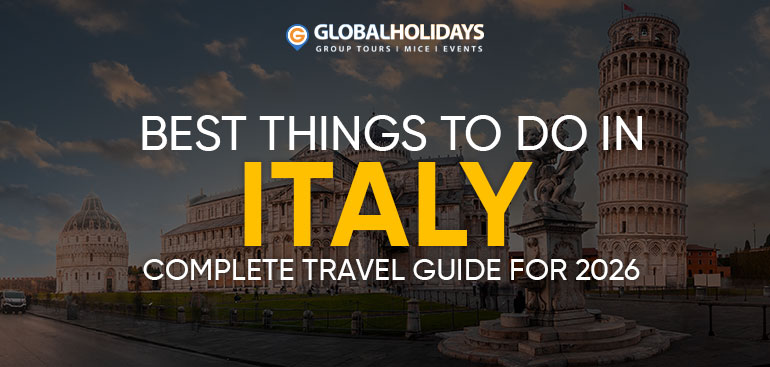
Pisa is often dismissed as a day-trip destination visited purely for the obligatory photograph with the Leaning Tower – but this underestimates the extraordinary quality of the architectural ensemble that surrounds it. The Campo dei Miracoli (Field of Miracles) in Pisa is one of the finest medieval architectural complexes in all of Europe, and the Leaning Tower is only one of its four remarkable buildings.
The Tower of Pisa is a freestanding bell tower that took nearly 200 years to build (from 1173 to 1372) and began leaning during construction due to the soft ground on one side of its foundation. At 56 meters tall and currently leaning at approximately 3.97 degrees from vertical (reduced from nearly 5.5 degrees following a stabilization project completed in 2001), the Tower is a remarkable feat of medieval engineering that has survived earthquakes, wars, and eight centuries of gradual subsidence.
The Cathedral (Duomo) of Pisa, which stands immediately beside the Tower, is the finest Romanesque cathedral in Italy and an architectural masterpiece in its own right: its facade is decorated with extraordinary carved marble columns and blind arcades, and its interior contains Galileo’s chandelier (which the scientist reportedly used to formulate his pendulum theory) and Giovanni Pisano’s magnificent marble pulpit. The Baptistery of Pisa, the largest in Italy, and the Campo Santo, a monumental medieval cemetery, complete this remarkable quartet of white marble buildings on the perfect green lawn of the Campo dei Miracoli.
Milan: Italy’s Fashion Capital and Gateway to the Alps
Milan is Italy’s most modern and economically dynamic city, a global capital of fashion, design, and finance that is also home to some of the country’s most extraordinary artistic and architectural treasures. It serves as the natural gateway from Italy to the Alps and is the starting point of the classic Italy-Austria-Switzerland multi-country tour route.
The Duomo di Milano (Milan Cathedral) is the third-largest church in the world and one of the most extraordinary Gothic buildings in existence. Construction began in 1386 and continued for nearly six centuries, resulting in a facade of astonishing complexity: 3,400 statues, 700 figures, and 135 spires crown the exterior, and visitors can take an elevator to the roof terrace and walk among the marble pinnacles for a close-up view of the sculpture and extraordinary panoramas over the city.
Leonardo da Vinci’s Last Supper (Il Cenacolo), painted between 1495 and 1498 on the refectory wall of the Convent of Santa Maria delle Grazie, is one of the most famous paintings in the world and an essential pilgrimage site for any visitor to Milan with an interest in art history. The mural depicts the moment described in the Gospel of John when Jesus announces that one of his disciples will betray him – capturing 13 individual reactions of shock, denial, and confusion with extraordinary psychological insight and compositional mastery. Visits must be booked well in advance, as only 25 people are admitted at a time in 15-minute slots.
The Galleria Vittorio Emanuele II, adjacent to the Duomo in Milan’s central piazza, is one of the world’s oldest shopping malls and a magnificent 19th-century architectural achievement: a four-story double arcade of shops and restaurants topped by a spectacular glass and cast iron roof. The Galleria houses some of Italy’s most prestigious brands alongside excellent cafes, and spinning your heel on the famous Toro mosaic in the floor for good luck is a Milanese tradition that every visitor observes.
Unique and Fun Things to Do in Italy Beyond the Classic Cities
Explore Cinque Terre: Five Colorful Villages on the Italian Riviera
Cinque Terre (“Five Lands”) is one of Italy’s most celebrated landscapes – a string of five dramatically situated medieval fishing villages perched on steep cliffs above the Ligurian Sea, connected by ancient footpaths and a coastal railway. The villages of Monterosso al Mare, Vernazza, Corniglia, Manarola, and Riomaggiore are individually charming and collectively magnificent, their colorful house facades rising from the rocky cliffsides in cascades of yellow, orange, pink, and terracotta. The network of hiking trails that connect them, including the famous Via dell’Amore (Lovers’ Walk), offers some of the most spectacular coastal scenery in Europe.
Discover Pompeii: The Ancient City Frozen in Time
Near Naples in southern Italy, the ancient Roman city of Pompeii was buried under six meters of volcanic ash and pumice in the catastrophic eruption of Mount Vesuvius on August 24, 79 CE. The eruption preserved the city almost exactly as it was at the moment of disaster – streets, houses, shops, temples, theatres, and artwork all sealed under ash for nearly 2,000 years. Today, the ongoing excavations at Pompeii offer one of the most extraordinary archaeological experiences in the world, a direct encounter with daily life in a prosperous Roman city at the height of the empire.
Drive the Amalfi Coast: Italy’s Most Spectacular Road
The Amalfi Coast, a 50-kilometer stretch of dramatic coastline south of Naples, has been designated a UNESCO World Heritage Site for its extraordinary landscape of terraced lemon groves, vertical cliffs plunging into turquoise water, and pastel-colored villages clinging to cliffsides. The coastal road (SS163) is one of the most spectacular drives in Europe, winding along sheer cliffs high above the sea with views that are consistently described as among the most beautiful in the world. The cliff-top village of Positano, the Cathedral of Amalfi, and the historic town of Ravello are the principal highlights of the coast.
Visit Tuscany’s Wine Country and Medieval Towns
Tuscany is perhaps Italy’s most famous and beloved region – a landscape of rolling hills dotted with cypress trees, stone farmhouses, medieval walled towns, and vineyards producing some of the world’s great wines. The Val d’Orcia, a UNESCO World Heritage Site southeast of Siena, offers the quintessential Tuscan landscape that appears on a thousand postcards and calendar photographs. The medieval hill towns of Siena, San Gimignano (famous for its medieval towers), Volterra, and Montalcino (home of the prestigious Brunello di Montalcino wine) are all within easy day-trip distance of Florence and offer an authentic taste of medieval Italy away from the tourist mainstream.
Perfect 10-Day Italy Itinerary
A 10-day Italy itinerary covering Rome, Florence, Venice, Pisa, and Milan is the most popular and highly recommended structure for a first Italy trip, and it is the foundation of the multi-country tours offered by Global Holidays USA. Here is how the ideal 10 days in Italy unfolds.
Days 1 and 2: Rome – The Eternal City
Arrive in Rome and spend Day 1 settling in, exploring the neighborhood around your hotel, and enjoying a first Italian dinner at a local trattoria. Day 2 is devoted to the full Rome city tour: a guided walk past the Colosseum and Arch of Constantine in the morning, continuing to the Roman Forum, Piazza Venezia, and the Trevi Fountain – the most beautiful fountain in Rome. In the afternoon, visit Vatican City and St. Peter’s Basilica. In the evening, explore the atmospheric streets of Trastevere for dinner.
Day 3: Pisa and Florence
After an early breakfast, drive west to Pisa and spend two hours at the Campo dei Miracles photographing the Leaning Tower and exploring the Cathedral, Baptistery, and Campo Santo. Continue to Florence in the afternoon, arriving in time to visit Piazzale Michelangelo for the sunset panorama over the city.
Day 4: Florence City Tour
Devote a full day to Florence: a guided walking tour through the UNESCO historic center, taking in the Duomo and Baptistery, the Basilica of Santa Croce, the Piazza della Signoria with the photo stop at the replica of Michelangelo’s David, and the Ponte Vecchio bridge over the Arno. Allow time for independent exploration in the afternoon.
Day 5: Florence to Venice
After breakfast, travel to Venice. The journey takes approximately two to three hours by coach or high-speed train. Arrive in Venice, take the boat ride to St. Mark’s Square, visit the Basilica di San Marco and the Bridge of Sighs, and enjoy the romantic gondola ride through the small canals. Overnight on the Venice mainland or in the city itself.
Day 6: Venice and Onward to Innsbruck or Switzerland
Spend the morning exploring Venice at leisure – the Rialto Bridge, the Grand Canal, and any of the smaller neighborhoods away from the main tourist circuit. After lunch, travel north toward Austria (Innsbruck) or Switzerland, depending on your chosen tour package itinerary.
Days 7 to 10: Austria, Liechtenstein, and Switzerland
The remaining days cover Innsbruck and the Swarovski Crystal World in Austria, a brief stop in tiny Liechtenstein, and the Swiss highlights of Mt. Titlis, Lucerne, Jungfraujoch, Bern, and Zurich – completing a spectacular multi-country Alpine journey that begins in ancient Rome and ends among the snow-capped peaks of the Swiss Alps.
This complete 10-day Italy and Alps itinerary is the foundation of the Classic Alps Odyssey: Italy-Austria-Switzerland package from Global Holidays USA – one of the most popular and highly recommended European tour packages for families and first-time visitors from the USA.
Best Time to Travel to Italy from USA
Italy is a year-round destination, but the best time to visit depends significantly on your priorities, budget, and tolerance for crowds and heat.
Late spring, specifically April through early June, is widely considered the ideal time to visit Italy. The weather is warm but not uncomfortably hot, the countryside and gardens are in full bloom, the major sites are fully operational, and the tourist crowds – while present – have not yet reached their peak summer intensity. Accommodation prices are moderate in this period, and the combination of beautiful light, pleasant temperatures, and manageable crowds makes it the sweet spot for first-time visitors.
Summer (July and August) is Italy’s peak tourist season. The weather is hot and sunny throughout the country, with temperatures regularly exceeding 35 degrees Celsius in Rome and Florence. The major sites are extremely crowded, accommodation prices are at their highest, and visiting cities like Rome and Venice in August can feel genuinely overwhelming. That said, summer is also when Italy’s coastal and lake destinations are at their most beautiful, and if Italy’s famous summer festivals and outdoor events are on your agenda, this is the time to go.
Early autumn, from September through October, rivals spring as the best time to visit Italy. The summer crowds have dissipated, the temperatures are pleasantly warm rather than scorching, the Tuscan vineyards are being harvested (creating the famous golden September landscapes), and the cultural calendar is particularly rich. This is the departure period for the Global Holidays USA Best of Europe and Europe Elegance packages, which include Italy alongside Switzerland, France, Germany, and other destinations.
Winter (November through February) offers the lowest prices and thinnest crowds but cooler weather and some reduced opening hours at outdoor sites. Rome is actually excellent to visit in winter – the major indoor attractions are open, the queues are short, and the city takes on a more authentic, less tourist-dominated character. Northern Italy and the Alps, on the other hand, are perfect for skiing from December through March.
Is It Safe to Travel to Italy?
Italy is a very safe country to visit, and the answer to the frequently asked question “is it safe to travel to Italy?” is a confident yes for the vast majority of travelers. Italy is a stable, democratic European country with excellent healthcare, reliable infrastructure, and a long tradition of welcoming international visitors. Violent crime against tourists is extremely rare, and Italy’s major tourist cities are generally safe for families, solo travelers, and group tours alike.
The primary safety concern in Italian tourist cities – and it is a minor one by global standards – is petty theft and pickpocketing, particularly in crowded tourist areas like the Colosseum, the Trevi Fountain, the Vatican, and St. Mark’s Square in Venice, as well as on public transportation. The simple precautions that apply in any major European city – keeping your valuables in a money belt or front pocket, being aware of your surroundings in crowded spaces, and not displaying expensive jewelry or electronics conspicuously – are all you need to stay safe.
For families and group travelers from the USA, traveling with a reputable tour operator like Global Holidays USA eliminates virtually all the logistical risks and uncertainties of independent travel in Italy. With expert tour managers, pre-booked accommodation, private transportation, and guided visits to all major sites, group travelers can focus entirely on enjoying Italy without worrying about navigation, language barriers, or security concerns.
From later in 2026, travelers from the USA will need to obtain an ETIAS (European Travel Information and Authorization System) travel authorization to enter Italy and other Schengen countries. This is a straightforward online process similar to the US ESTA system, with a fee of approximately €7. Always check the official EU ETIAS website at travel-europe.europa.eu for the latest requirements before booking.
Italy Trip Cost from USA: What to Budget in 2026
Italy offers a wide range of budgets depending on the standard of accommodation you choose, how many paid attractions you visit, and whether you eat at tourist restaurants or local trattorias. Understanding the likely costs helps you plan realistically and choose between an independent trip and a guided tour package.
For independent travelers from the USA, a 10-day Italy trip covering Rome, Florence, Venice, and Pisa typically costs between $3,500 and $7,000 per person, including round-trip flights ($700 to $1,400 depending on season and booking lead time), accommodation ($100 to $300 per night depending on city and hotel category), inter-city train tickets (roughly $30 to $80 per journey on high-speed services), major entrance fees (Colosseum and Roman Forum combined ticket is approximately €20, Vatican Museums €17 to €32 depending on the tour, gondola ride in Venice €80 to €120 for a shared boat), and daily meals and incidentals.
Booking an Italy tour package through Global Holidays USA packages all major costs into a single price, providing significant savings compared to booking each element individually, while also eliminating the considerable time investment of independent planning.
Italy Tour Packages from USA
Global Holidays USA has over 24 years of expertise in crafting outstanding European vacation experiences for Indian families, NRI travelers, and first-time visitors from the USA. Every Italy tour package includes the services of experienced, multilingual tour managers, quality accommodation, all transportation within the itinerary, Indian and local vegetarian meal options, and entrance fees for all major attractions. Here are the Italy-inclusive packages currently available.
- Classic Alps Odyssey: Italy, Austria & Switzerland – 10 Days
- Gems of Europe: Colosseum to Eiffel Tower – 11 Days
- Best of Europe – 10 Days from $2,999 per person
- Europe Elegance – 16 Days from $4,999 per person
- Grand Europe Tour Package
- UK with Europe Tour Package
Essential Italy Travel Tips for Visitors from the USA
Train Travel: Italy’s high-speed train network (Frecciarossa) connects Rome, Florence, and Venice quickly and comfortably. Rome to Florence takes approximately 90 minutes, and Florence to Venice takes around 2 hours 15 minutes. Tickets should be booked in advance, especially in summer, as popular services sell out weeks ahead. All Global Holidays USA Italy packages handle inter-city transportation by private AC coach.
Dress Code at Religious Sites: Shoulders and knees must be covered to enter St. Peter’s Basilica, the Vatican Museums, the Sistine Chapel, and most Italian churches. Carry a scarf or light wrap to use as a cover-up – many churches have dressing rooms or scarves available to borrow at the entrance.
Book Key Attractions in Advance: The Colosseum, Vatican Museums, Uffizi Gallery in Florence, and gondola rides during peak season can have wait times of several hours if you arrive without a reservation. All major attractions in the Global Holidays USA Italy packages are pre-booked, eliminating this problem entirely for group travelers.
Currency and Tipping: Italy uses the Euro. Credit cards are widely accepted in hotels, restaurants, and shops, but smaller businesses and market stalls often prefer cash. Tipping is not mandatory in Italy but is appreciated – rounding up to the nearest Euro or leaving 10% at a restaurant where you received good service is customary.
Food for Indian and Vegetarian Travelers: Italian cuisine is inherently very vegetarian-friendly, with excellent pasta dishes, pizza, salads, and grilled vegetable preparations available throughout the country. Indian restaurants are found in major Italian cities. Global Holidays USA tours include Indian vegetarian dinner options throughout the itinerary, ensuring that Indian families and vegetarian travelers always have familiar, satisfying meal options.
ETIAS Requirement (New for 2026): From later in 2026, US citizens will need an ETIAS travel authorization to enter Italy and all other Schengen countries. Apply through the official EU website at travel-europe.europa.eu. The process is similar to the US ESTA and costs approximately €7.
Conclusion
Italy is not a destination you simply visit. It is a destination that becomes part of you. Standing in the Roman Forum and feeling the weight of 2,500 years of civilization pressing down through the ancient stones. Walking across the Ponte Vecchio at dusk and watching the Arno turn to gold below you. Gliding through the silent canals of Venice on a gondola as the city settles into its evening light. Looking up at the dome of St. Peter’s Basilica and understanding, for the first time, what human beings are truly capable of when they are inspired.
Italy rewards every traveler who comes to it with curiosity, patience, and an open heart – and it gives more generously than almost anywhere else on Earth. Whether you are making your first trip to Europe, returning to Italy for the third time, or bringing your family to experience the country’s extraordinary combination of history, art, landscape, and cuisine, Italy will meet you exactly where you are and give you something unforgettable.
With Global Holidays USA’s expertly crafted Italy tour packages – from the Classic Alps Odyssey to the Gems of Europe and the Best of Europe – every detail of your Italian journey is planned, managed, and perfected by professionals with over 24 years of experience. All you need to do is arrive, look around, and let Italy do the rest. Browse our full range of Europe tour packages or call us toll-free at +1 844-900-8099 to start planning your dream Italy trip today.
La Dolce Vita Awaits You
 Axar Tours Global Holidays LLC.