
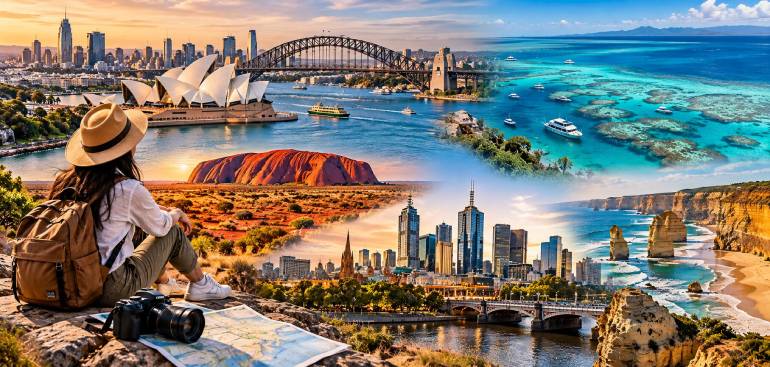
Why You Need an Australia Travel Itinerary
An Australia Travel Itinerary helps you explore major cities, beaches, wildlife and natural wonders within your available time. A 7-day trip suits first-time visitors with limited time. A 10-day trip allows more variety. A 14-day trip gives you a broader experience. A 17-day journey allows you to combine several major Australian destinations at a comfortable pace.
Australia is enormous, so trying to cover the entire country in one trip can create unnecessary travel time. Instead, choose a region or connect destinations with domestic flights.
For example, an east coast route can combine Sydney, Melbourne, Cairns and the Gold Coast. You can also add Uluru, Adelaide or another regional destination if you have more time.
Tourism Australia features itineraries ranging from short city breaks to longer regional journeys. Its itinerary collection also highlights road trips, natural wonders, beaches, wildlife and cultural experiences.
For travelers planning Australia Travel from USA, smart planning matters even more. Long flights make it useful to maximize your time after arrival.
How Many Days Do You Need for Australia?
The ideal trip length depends on your interests and travel style.
A 7-day Australia vacation itinerary works well for a focused trip. You can experience Sydney and add one more major destination.
A 10-day Australia itinerary gives you enough time for several highlights. Sydney, Melbourne and Cairns can form a practical route.
A 14-day Australia travel itinerary allows more flexibility. You can add the Gold Coast, Uluru or another destination.
A 17-day Australia trip provides even more room for sightseeing and relaxation. It can also work well for travelers combining Australia with New Zealand.
There is no single route that suits every traveler. Therefore, choose destinations based on the experiences you want most.
Australia Travel Itinerary: 7-Day Trip
A 7-day itinerary should focus on two or three destinations. Avoid adding too many domestic flights.
Days 1–3: Sydney
Start your Australia Travel Itinerary in Sydney.
Spend your first day exploring Sydney Harbour and the city’s famous landmarks. Visit the Sydney Opera House and walk around Circular Quay.
You can also explore The Rocks and enjoy views of the Harbour Bridge.
On the second day, visit Bondi Beach and explore Sydney’s coastal scenery. The Bondi to Coogee area offers excellent walking opportunities.
On day three, consider a Blue Mountains day trip. Katoomba and the Three Sisters offer a change from the city.
Blue Mountains access is also relatively convenient from Sydney. Tourism Australia highlights the area as an easy excursion from the city.
Days 4–5: Melbourne
Fly from Sydney to Melbourne.
Spend your first day exploring Melbourne’s central areas. Visit Federation Square, the Royal Botanic Gardens and nearby cultural attractions.
Melbourne is also known for its food and café culture.
On day five, choose between a city-focused day and a nearby excursion.
The Great Ocean Road is another option if you prefer coastal scenery. However, a full-day road trip can make this itinerary busy.
Days 6–7: Great Barrier Reef
For a different experience, fly to Cairns.
Spend day six exploring Cairns or joining a reef excursion.
Use day seven for the Great Barrier Reef.
Cairns provides access to reef experiences, including snorkeling and diving. Tourism Australia also recommends Cairns as a gateway to the reef.
If your international flight schedule makes this route difficult, keep your 7-day trip within Sydney and Melbourne.
That approach reduces airport transfers and gives you more sightseeing time.
Australia Travel Itinerary: 10-Day Trip
A 10-day Australia Vacation Itinerary gives you more options.
One practical route connects Sydney, Melbourne and Cairns. Another focuses on the east coast with Sydney, Brisbane, the Gold Coast and Cairns.
Tourism Australia also features a 10-day east coast route connecting Sydney, coastal New South Wales, the Gold Coast and Cairns.
Days 1–3: Sydney and Blue Mountains
Spend three days in Sydney.
Visit the Opera House, Harbour Bridge, Bondi Beach and The Rocks.
Use one day for the Blue Mountains.
You can travel by train or join a guided excursion. This gives you city sightseeing and natural scenery without changing hotels.
Days 4–5: Melbourne
Take a domestic flight to Melbourne.
Explore the city on day four.
On day five, consider the Great Ocean Road or Phillip Island.
Phillip Island can be a good choice for travelers interested in wildlife.
Days 6–7: Cairns and Great Barrier Reef
Fly to Cairns.
Spend one day exploring the city and surrounding rainforest.
Use the next day for the Great Barrier Reef.
You can choose snorkeling, diving or glass-bottom boat experiences based on your interests.
Days 8–10: Gold Coast or Brisbane
Fly south to Brisbane or the Gold Coast.
Spend time enjoying beaches, shopping and local attractions.
Families can also consider theme parks around the Gold Coast.
Another option is to extend your Cairns stay. This works well for travelers who prefer nature and outdoor experiences.
A 10-day trip should not attempt to cover every major Australian region.
Australia is too large for that approach. Therefore, focus on a connected route.
Australia Travel Itinerary: 14-Day Trip
A 14-day Australia Travel Itinerary provides more flexibility.
You can combine major cities with natural attractions without changing locations every day.
Days 1–3: Sydney
Start in Sydney.
Explore the harbour, Opera House, Harbour Bridge and Bondi Beach.
Reserve one day for the Blue Mountains.
You can also keep your third day flexible. Use it for shopping, food experiences or additional sightseeing.
Days 4–5: Melbourne
Fly to Melbourne.
Spend one day exploring the city.
On the second day, choose the Great Ocean Road or Phillip Island.
The choice depends on your interests.
The Great Ocean Road suits travelers who enjoy coastal scenery. Phillip Island works well for wildlife experiences.
Days 6–8: Cairns
Fly to Cairns.
Spend three days exploring tropical North Queensland.
Reserve one full day for the Great Barrier Reef.
Use another day for Kuranda or rainforest experiences.
Keep the third day flexible for Cairns, Port Douglas or another local experience.
Tourism Australia lists both reef and rainforest experiences among its key northern Queensland itinerary ideas.
Days 9–10: Gold Coast
Fly to the Gold Coast.
Spend time on the beaches and explore the surrounding area.
Families can include theme parks in their itinerary.
Couples may prefer beaches, restaurants and relaxed coastal activities.
Days 11–12: Uluru or Adelaide
With two additional days, you can add a different side of Australia.
Uluru provides an outback experience with dramatic landscapes and Indigenous cultural connections.
Alternatively, choose Adelaide for food, wine and nearby regional experiences.
Tourism Australia includes central Australia and Adelaide among its longer itinerary options.
Days 13–14: Sydney and Departure
Return to Sydney for your international flight.
If possible, leave some time before your departure.
This creates a buffer for domestic travel delays.
It also gives you time for last-minute shopping or a relaxed final meal.
Australia Travel Itinerary: 17-Day Trip
A 17-day trip works well for travelers who want a more complete Australia experience.
It also creates enough time to combine Australia with New Zealand.
However, if you want to focus only on Australia, you can use all 17 days within the country.
Days 1–3: Melbourne
Begin your Australia trip in Melbourne.
Explore the city’s architecture, gardens, markets and cultural attractions.
Spend one day visiting major city highlights.
Use another day for a regional excursion.
Days 4–5: Great Ocean Road and Phillip Island
Take a Great Ocean Road trip on day four.
The route offers dramatic coastlines, beaches and famous rock formations.
Return to Melbourne or stay nearby based on your travel plans.
On day five, visit Phillip Island.
Wildlife experiences make this a popular addition to an Australia tour.
Days 6–8: Cairns and Great Barrier Reef
Fly to Cairns.
Spend three days exploring the tropical north.
Reserve one day for the Great Barrier Reef.
Use another day for rainforest experiences.
Keep your third day flexible for Cairns or Port Douglas.
Days 9–12: Sydney and Blue Mountains
Fly to Sydney.
Spend your first two days exploring the city.
Visit the Opera House, Harbour Bridge, Bondi Beach and The Rocks.
Reserve another day for the Blue Mountains.
Keep the final day flexible.
You can enjoy a harbour cruise, shopping or additional coastal experiences.
Days 13–14: Gold Coast
Travel to the Gold Coast.
Relax on the beaches and explore the surrounding attractions.
Families can add theme parks.
Couples can focus on beaches, dining and coastal experiences.
Days 15–17: Brisbane and Departure
Travel to Brisbane.
Spend time exploring the city and nearby areas.
You can also use Brisbane as your departure point if international flight schedules allow.
This route combines cities, beaches, wildlife, rainforest and coastal scenery.
It also avoids trying to see every corner of Australia.
Which Australia Travel Itinerary Is Right for You?
Your ideal Australia Travel Itinerary depends on your available time.
7 Days
Choose seven days if you want a short introduction to Australia.
Focus on Sydney and one additional destination.
10 Days
Choose ten days if you want a balanced first trip.
Sydney, Melbourne and Cairns offer a strong combination of city and nature experiences.
14 Days
Choose fourteen days if you want more variety.
You can add the Gold Coast, Uluru or Adelaide.
17 Days
Choose seventeen days if you want a longer Australia vacation.
You can explore more regions at a relaxed pace.
You can also consider combining Australia and New Zealand.
How to Travel Around Australia During Your Trip
Australia’s large distances make transportation an important part of your planning.
Domestic flights are often the most practical option between distant cities.
For example, flying between Sydney, Melbourne and Cairns saves substantial travel time.
Road trips work better when destinations are relatively close.
The Pacific Coast route is one example. It connects Sydney with coastal destinations before reaching Queensland.
Trains can also work well for selected journeys.
However, Australia is not a country where one rail pass automatically solves every long-distance journey.
Therefore, compare flight, train and road options before booking.
For a first Australia Tour, combining domestic flights with short road trips can provide a good balance.
Best Time to Follow an Australia Travel Itinerary
Australia has different climates across its regions.
Therefore, the best travel season depends on your itinerary.
Spring runs from September to November. Autumn runs from March to May.
These seasons can offer comfortable conditions in many parts of the country.
For an east coast itinerary, shoulder seasons can also offer a balance between weather and visitor numbers. Tourism Australia notes September to November and March to May as useful shoulder-season periods for its east coast budget route.
Summer can be excellent for beaches and coastal destinations.
However, northern Australia can experience tropical weather during this period.
Winter can be attractive for some southern destinations.
It can also be a good time for certain northern Australian experiences.
Always check regional weather before finalizing your route.
Australia Travel From USA: What First-Time Visitors Should Know
Travelers planning Australia Travel from USA should prepare for a long journey.
Your itinerary should account for arrival time and jet lag.
Avoid scheduling a major excursion immediately after a long international flight.
Instead, spend your first day exploring at a relaxed pace.
Check Your Entry Requirements
U.S. passport holders need the appropriate Australian travel authorization before entering Australia.
Eligible travelers can apply for an Electronic Travel Authority through the Australian ETA system. The ETA allows eligible visitors to stay for up to three months per visit.
Always check the latest requirements before departure.
Plan Domestic Flights Early
Australia’s major attractions are spread across large distances.
Therefore, domestic flights can become an important part of your itinerary.
Book major travel segments early when your dates are fixed.
Prepare for Different Weather
A single Australia trip can include several climate zones.
Melbourne may feel very different from Cairns.
Therefore, pack layers and weather-appropriate clothing.
Carry Sun Protection
Australian outdoor activities often involve significant sun exposure.
Pack sunscreen, sunglasses, a hat and comfortable walking shoes.
Also carry a reusable water bottle during sightseeing.
Tips for Planning a Comfortable Australia Vacation Itinerary
A good Australia Vacation Itinerary should include both sightseeing and downtime.
Avoid changing hotels every night.
Instead, stay several nights in major destinations.
This reduces packing and transportation stress.
Also leave some flexibility for weather.
Reef cruises and outdoor activities can sometimes depend on conditions.
For example, Australia’s official itinerary options often combine flights, cars and boats.
That combination can help you cover more ground.
However, too many transportation changes can make a vacation tiring.
Choose experiences that match your travel style.
Families may need more free time.
Senior travelers may prefer fewer hotel changes.
Couples may want more time for dining and scenic experiences.
Group travelers can benefit from planned transfers and organized sightseeing.
Plan Your Australia Tour From the USA
Planning a long-distance trip becomes easier when your itinerary, accommodation and transportation work together.
Global Holidays USA offers organized international tour packages for travelers from the USA.
Its Grand Australia & New Zealand package is a 17-day journey covering Melbourne, Cairns and Sydney in Australia. It then continues through Christchurch, Queenstown, Rotorua and Auckland in New Zealand.
The Australia portion includes experiences such as the Great Ocean Road, Phillip Island, Kuranda Skyrail, Great Barrier Reef, Sydney Opera House and Blue Mountains.
If you prefer a planned group experience, this package can combine multiple destinations without requiring you to arrange every transfer separately.
Contact Global Holidays USA to discuss your preferred travel dates, itinerary and Australia vacation requirements.
Conclusion
The best Australia Travel Itinerary depends on how much time you have and what you want to experience. Choose 7 days for a focused trip, 10 days for major highlights, 14 days for greater variety, or 17 days for a longer Australia and New Zealand journey.
Australia offers much more than major cities. Your Australia Travel experience can include beaches, wildlife, rainforests, reefs, mountains, road trips and cultural experiences.
For first-time travelers from the USA, planning the route around regional distances is especially important.
A well-planned Australia Tour can therefore give you more sightseeing time and less time spent moving between destinations.
 Axar Tours Global Holidays LLC.