
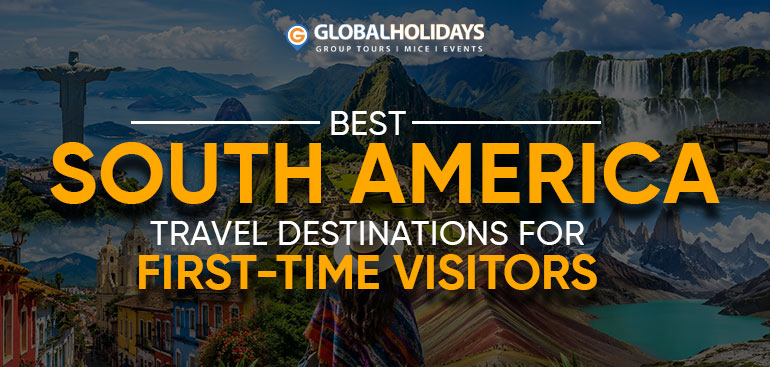
South America is one of the world’s most thrilling travel regions. It is also one of the most misunderstood. Many first-time visitors don’t know where to start. If that sounds familiar, this guide to the best South America destinations will help you plan with clarity and confidence. From the ancient Inca citadel of Machu Picchu in Peru to the carnival energy of Rio de Janeiro in Brazil, from Colombia’s walled city of Cartagena to Chile’s otherworldly Atacama Desert – this continent holds landscapes, cultures, and experiences found absolutely nowhere else on Earth.
This guide covers the top South America travel destinations for first-timers, the best time to travel to South America, practical travel tips from the USA, and how to book the right South America travel packages for your budget and style.
Why South America Should Be Your Next Big Adventure
South America is a continent of extraordinary scale. It holds the world’s longest mountain range (the Andes), the world’s largest river basin (the Amazon), the driest place on Earth (the Atacama Desert), and the world’s most biodiverse rainforest.
For first-time visitors, the continent can feel both exciting and overwhelming. However, modern tourism infrastructure across major destinations has improved enormously in recent years. Countries like Brazil, Argentina, Peru, and Chile are welcoming more visitors than ever, thanks to better infrastructure, expanded flight routes, and improved safety across tourist corridors.
South America also offers remarkable value for US travelers. The exchange rate works in your favor in most countries, meaning your travel dollar goes considerably further here than in Europe or Japan.
So the question isn’t whether South America is worth visiting. The question is: where do you start?
Best South America Destinations: Country-by-Country Guide
Peru: Home to Machu Picchu and Ancient Inca Wonders
Peru is the most popular starting point for a reason. It combines two of the continent’s most iconic experiences – Machu Picchu and Cusco – with excellent tourism infrastructure, a world-class food scene centered on Lima, and a range of landscapes from the Amazon to the Andes.
Machu Picchu is the crown jewel. Nestled within a tropical Peruvian forest almost 8,000 feet above sea level, this UNESCO World Heritage Site is typically reached by taking a train to Aguas Calientes or hiking the 26-mile Inca Trail. However, the Inca Trail requires booking months in advance due to strict daily visitor limits. Alternative routes, such as the Salkantay Trek and Lares Trek, offer equally stunning mountain scenery with far fewer crowds.
Cusco, the former capital of the Inca Empire, serves as your base for the region. Its Plaza de Armas is one of South America’s most beautiful central squares, surrounded by Baroque cathedrals built directly on top of Inca stone foundations. The Sacred Valley, stretching between Cusco and Aguas Calientes, contains Inca agricultural terraces at Moray, the salt pans of Maras, and the fortress of Ollantaytambo – all outstanding day trips.
Lima, Peru’s coastal capital, has quietly become one of the world’s great culinary cities. Lima is known as a top culinary destination in South America. While you’re here, try Peruvian ceviche and a Pisco sour, the city’s signature drink. Restaurants in Miraflores and Barranco serve ceviches, tiraditos, and causa dishes that have earned global recognition.
Also on Peru’s must-see list: the floating reed islands of Lake Titicaca, shared with Bolivia; the Rainbow Mountain (Vinicunca) trek near Cusco; and the mysterious Nazca Lines – enormous geoglyphs etched into the desert floor that remain one of archaeology’s great unsolved puzzles.
Best for: History and culture lovers, bucket-list hikers, food travelers, and first-timers who want a well-organized South America experience.
Peru travel tip: The optimal time for visiting Peru is the shoulder season – May through June and September through October – which offers smaller crowds, plenty of blue skies, and dry weather. Also note that Machu Picchu closes for maintenance during the month of February.
Brazil: Beaches, Jungle, and Carnival Energy
Brazil is the ideal place to start for many travelers. It’s iconic, incredibly diverse and offers an unmatched blend of beach, culture, nature and celebration. From the legendary beaches of Rio de Janeiro and the colonial charm of Salvador de Bahia to the lush Atlantic rainforest and vibrant local cuisine, Brazil delivers the full South American experience in one destination.
Rio de Janeiro is Brazil’s most visited city and one of the world’s most naturally beautiful. With its plentiful beaches, dramatic mountains, and backdrop of samba and bossa nova rhythms, it’s easy to fall in love with Rio de Janeiro. The iconic Christ the Redeemer statue, perched atop Corcovado Mountain at 2,310 feet, looks over the entire city. Sugarloaf Mountain, reached by cable car in two stages, offers sweeping 360-degree views of Guanabara Bay. Copacabana and Ipanema beaches deliver everything their legendary reputations promise.
Iguazu Falls, straddling the border of Brazil and Argentina, is one of the most spectacular natural sights on Earth. The falls stretch nearly 2 miles wide and include 275 individual cascades plunging up to 269 feet. Both the Brazilian and Argentine sides offer dramatically different perspectives – the Brazilian side gives you the panoramic view, while the Argentine side puts you right inside the spray on elevated walkways.
The Amazon Rainforest, most easily accessed from the city of Manaus in northern Brazil, is the world’s most biodiverse ecosystem. The best and easiest way to get around this dense rainforest is on the water, so river cruises tend to be the most popular among visitors. An 8-hour Amazon jungle trek combined with a riverboat visit to the Meeting of the Waters – where the dark Rio Negro meets the lighter-colored Amazon River and the two flow side by side for 6 kilometers without mixing – is one of Brazil’s most memorable experiences.
Rio’s Carnaval, held in the days before Ash Wednesday (usually February or early March), is the world’s largest party. Imagine immersing yourself in the pulsating rhythms of Carnaval in Brazil – this is South America’s most electric cultural event. Accommodation books up many months in advance.
Best for: Beach lovers, nature enthusiasts, culture seekers, wildlife travelers, and anyone who wants to experience the sheer energy and diversity of the world’s fifth-largest country.
Brazil travel tip: December through March is peak summer in Brazil, offering the best beach weather and Carnival season energy. However, this is also peak season for crowds and prices. The shoulder months of April through June offer warm weather with fewer tourists and lower hotel rates.
Colombia: The Most Welcoming Country in South America
Colombia’s transformation over the past two decades is one of the great travel stories of the 21st century. Once infamous for dangerous gangs and drug activity, Medellín has been transformed. It’s now a vibrant destination for travelers seeking a culturally rich vacation. The same story, in broader strokes, applies to the country as a whole.
Colombia is a strong first-timer choice, particularly Cartagena and Medellín, for its warm people, easy domestic connections, and incredible variety packed into a relatively compact country.
Cartagena is Colombia’s jewel. The well-preserved walled city of Cartagena, its basic structure unaltered for centuries, has a charm and mystique unrivaled anywhere in the country. With intimate plazas and sturdy fortifications, the former trade port is an evocative place for lovers of history, romance and good food. The colors of the Old City – bougainvillea cascading down mustard-yellow colonial walls, bright-painted balconies, cobblestoned plazas – make it one of the most photogenic cities in all of Latin America.
Medellín, once the world’s most dangerous city, is now a celebrated example of urban reinvention. It hosts Pablo Escobar tours for those curious about its history, while its street-art scene, cable car neighborhoods, and thriving café culture reflect a city that has genuinely moved forward.
The Coffee Triangle, or “Zona Cafetera,” is Colombia’s principal coffee-growing area. Visitors can experience lush green valleys, exotic wildlife, and a pleasant climate – the perfect place to unwind while enjoying the freshest cup of coffee you’ll ever taste.
Tayrona National Natural Park, on Colombia’s Caribbean coast near Santa Marta, is a paradise of forested coastal trails leading to pristine swimming coves. The combination of jungle-to-beach hiking and crystalline Caribbean water makes it one of South America’s most rewarding natural experiences.
Best for: First-time South America travelers who want a compact, diverse experience. Also excellent for food lovers, history enthusiasts, coffee aficionados, and urban culture seekers.
Colombia travel tip: Colombia sits near the equator. Therefore, its seasons are defined by wet and dry cycles rather than temperature. The driest months along the Caribbean coast are December through April and July through August – the best times for Cartagena and Tayrona.
Argentina: Tango, Patagonia, and Everything In Between
Buenos Aires captivates visitors with its vibrant cafés and late-night dance halls. Beyond the city, Patagonia stretches toward Antarctica, glaciers creaking like old doors. Argentina is, in a word, spectacular – and remarkably diverse.
Buenos Aires is often called the “Paris of South America,” and while the comparison is imperfect, the city does share something of Paris’s grand boulevards, European-influenced architecture, and intensely café-centric culture. The Recoleta neighborhood, with its famous cemetery housing the mausoleum of Eva Perón, feels aristocratic and European. La Boca, with its corrugated-iron houses painted in brilliant colors and tango dancers performing in the streets for visitors, is Buenos Aires at its most vivid. Palermo, the city’s hippest neighborhood, offers excellent restaurants, craft cocktail bars, and boutique design shops. Watching a live tango show is, simply, one of the most viscerally exciting cultural experiences South America offers.
Iguazu Falls, which Argentina shares with Brazil, is even more immersive from the Argentine side. The Garganta del Diablo – Devil’s Throat – walkway takes you directly to the edge of the most powerful cascade, where the noise and spray make conversation impossible, and the scale of the falls becomes completely overwhelming.
Patagonia is Argentina’s crown wilderness. Torres del Paine National Park in Chilean Patagonia, combined with Argentina’s Los Glaciares National Park, offers some of the most dramatic scenery on the planet, including turquoise lakes, the Grey Glacier, and the soaring Cuernos del Paine peaks. The Perito Moreno Glacier, near El Calafate in Argentina, is one of the few glaciers in the world that is not currently retreating – and watching massive chunks of blue ice calve into the lake below is a genuinely breathtaking experience.
Mendoza, in the Andean foothills of western Argentina, is the heart of the country’s wine country. The region produces Malbec wines considered among the best in the world, and touring the bodegas against a backdrop of snowcapped Andean peaks is a sublime experience for wine lovers.
Best for: Travelers who want big-city culture AND dramatic wilderness. Also excellent for wine lovers, tango enthusiasts, and adventure hikers.
Argentina travel tip: The best time to go to Argentina is from September to November when the weather is favorable throughout the country. For Patagonia specifically, December to February provides the warmest temperatures and longest daylight hours for hiking.
Chile: From the Atacama Desert to Patagonia’s Glaciers
Chile is one of the world’s most geographically extraordinary countries. It stretches 2,653 miles from north to south along the western edge of South America – yet is never more than 217 miles wide. Within that narrow strip, you move from the driest desert on Earth to temperate rainforests to glacial Patagonia.
The Atacama Desert is the driest place on Earth. It provides a lunar landscape that feels truly otherworldly. The town of San Pedro de Atacama is your base for adventure. You can visit geysers that erupt at dawn – the El Tatio geysers require early-morning departures. The salt flats are home to flamingo species, and many observatories offer nighttime tours for amateur astronomers. Stargazing in the Atacama, where the absence of humidity and light pollution creates the clearest night skies in the world, is simply unforgettable.
Santiago, Chile’s capital, sits in a valley surrounded by the Andes and is a sophisticated, modern city with outstanding food, wine, and museums. The Barrio Bellavista neighborhood is the cultural heart, while the hilltop Cerro San Cristóbal gives panoramic views of the city with Andean peaks as a backdrop on clear days.
Torres del Paine National Park in Chilean Patagonia is the legendary trekking destination. The W Trek covers the park’s most iconic viewpoints over five days. The full O Circuit takes eight to nine days and is considered one of the world’s great long-distance hikes. Reservations for campsites and refugios must be made months in advance. Reaching Torres del Paine isn’t easy, but beholding the ice fields and soaring peaks of Cuernos del Paine is more than worth the trip.
The Chilean Lake District, around Pucón and Puerto Varas, offers a green and beautiful contrast to both the desert and Patagonia. Volcano climbing, kayaking on lakes, and soaking in natural hot springs make it one of South America’s best adventure destinations.
Best for: Adventure travelers, nature lovers, stargazers, hikers, and anyone who wants extreme landscape diversity in one destination.
Chile travel tip: The best time to visit Chile and Argentina’s Patagonia region is October through April, with December through February being the core season for long daylight hours and access to trails. The Atacama is excellent year-round, though winter nights (June to August) produce the clearest stargazing skies.
Ecuador and the Galápagos Islands: A Wildlife Lover’s Dream
Ecuador is a compact country that packs in astonishing diversity. You can experience the Amazon Rainforest, the Andes highlands, colonial Quito, and the Pacific coast – all within a country roughly the size of Nevada.
Quito, the capital of Ecuador, is one of the best cities to visit in South America. Sprawling across an ancient plateau high in the Andean mountains, it is where history and culture converge. The breathtaking historical center is a UNESCO World Heritage Site, a treasure trove of centuries-old churches, museums, and galleries. The Church and Convent of San Francisco, the largest colonial building in the Americas, and the ornate Church of La Compañía de Jesús are among its finest monuments.
However, the Galápagos Islands are Ecuador’s most extraordinary attraction. The Galápagos are a living laboratory of evolution. Strictly managed tourism helps protect this delicate ecosystem. Visitors can choose between cruise-based or land-based tours. Because the islands’ wildlife evolved without natural predators, animals show no fear of humans. You can sit two feet from a sea lion without it flinching. Blue-footed boobies perform their courtship dances right beside your hiking trail. Giant tortoises lumber past at a pace that makes you feel time itself has slowed. No wildlife experience in the Western Hemisphere compares to it.
The Galápagos Islands are a year-round destination. December to May offers warmer waters and calm seas; June to November brings cooler, nutrient-rich waters and exceptionally active marine life.
Best for: Wildlife enthusiasts, nature lovers, photographers, and travelers who want a genuinely once-in-a-lifetime experience unlike anything else in South America.
Ecuador travel tip: The Galápagos require booking well in advance. Cruise-based tours provide access to more islands and more wildlife encounters, while land-based tours offer a more affordable option and a chance to support local island communities.
When Is the Best Time to Travel to South America?
This is one of the most common questions first-time visitors ask, and the honest answer is: it depends on where you’re going.
South America sits in the Southern Hemisphere. Therefore, its seasons are the exact opposite of those in North America. When it’s winter in the US and Canada, much of South America is in summer – and vice versa. This is important to keep in mind when planning a trip to South America.
The peak of summer, stretching from December to March, is the best time to visit South America’s most popular cities. This period brings vibrant energy to cities like Rio de Janeiro and Buenos Aires, with world-famous festivals like Brazil’s Carnaval.
However, peak season also means higher prices and larger crowds. The shoulder months of March to May and September to November offer the best value, with flights and hotels 20 to 40 percent below peak rates.
Best Time by Destination
Peru (Machu Picchu and Cusco): The dry season runs from May to September and is considered the optimal time for visiting Machu Picchu. Shoulder months of May–June and September–October offer fewer crowds and dry conditions. Note that Machu Picchu and the Inca Trail close for maintenance during February.
Brazil (Rio, Amazon, Iguazu Falls): December through March is the best time to visit Brazil’s beaches and experience Carnaval. However, the Amazon is best visited July through December for low-water season, when animals concentrate near rivers and land hiking is easiest.
Colombia (Cartagena, Medellín, Coffee Triangle): Colombia sits near the equator with two dry seasons – December through March and July through August – making those the best periods for beach and coastal travel. Medellín has spring-like weather year-round thanks to its altitude.
Argentina (Buenos Aires, Patagonia, Mendoza): Spring (September to November) is one of the most enjoyable times to visit Buenos Aires – bright days, jacaranda trees in bloom, and comfortable temperatures. For Patagonia, December through February is the core season for trekking. Mendoza is at its most beautiful in March and April during the wine harvest.
Chile (Atacama, Santiago, Patagonia): The Atacama is excellent year-round. Patagonia’s season runs November through March. Santiago is comfortable from spring through fall (October through April).
Ecuador and Galápagos: April and May are excellent months for the Galápagos, with warm waters suitable for extended snorkeling and abundant wildlife sightings.
Overall best value timing: The shoulder seasons of spring (September to November) and fall (March to May) offer the best balance of comfortable weather, lighter crowds, and lower prices across most South American destinations.
South America Travel Guide: Essential Tips for First-Timers from the USA
Visiting South America for the first time is tremendously exciting. Also, a little preparation goes a long way.
Book popular attractions in advance.
Machu Picchu has strict daily visitor limits. The Inca Trail and other popular trekking routes fill months ahead. Galápagos cruise cabins sell out early. Reserve tickets before you book your flights.
Understand altitude sickness.
Cusco sits at 11,152 feet (3,399 meters) above sea level. La Paz, Bolivia, sits even higher at 11,942 feet. Altitude sickness – headaches, nausea, fatigue – is common on arrival at high elevations. Spend your first day resting, stay hydrated, avoid alcohol, and consider altitude medication (consult your doctor before travel).
Currency and cash.
Credit cards are widely accepted in cities and tourist areas across Peru, Brazil, Colombia, and Argentina. However, in smaller towns, rural areas, and markets, cash is king. Carry local currency for these situations. Also note that Argentina in particular has had complex currency exchange dynamics in recent years – always check current guidance before exchanging money.
Language.
Spanish is the official language in most South American countries. Brazil speaks Portuguese. In tourist areas of major cities like Cartagena, Lima, Buenos Aires, and Rio de Janeiro, English is widely spoken. Outside tourist corridors, basic Spanish will serve you extremely well. Download Google Translate with Spanish and Portuguese available offline before you leave home.
Safety.
Safety varies significantly by country and city. Popular tourist destinations like Cusco, Buenos Aires, Cartagena, and the Atacama are generally well set up for visitors and considered safe with the usual precautions. Standard advice applies: avoid displaying expensive jewelry and electronics, use reputable transport apps (Cabify and Uber operate in most major cities), and research neighborhoods before exploring on foot at night.
Visas.
US passport holders do not require a visa for tourist stays in most South American countries. You can enter Peru, Colombia, Argentina, Chile, Ecuador, and Brazil visa-free for up to 90 days with a valid US passport. Always verify current entry requirements before departure, as these occasionally change.
Best South America Travel Packages from the USA
Planning a multi-country South American trip independently can be rewarding – but also complex. Coordinating internal flights, trains, border crossings, accommodation, and guided tours across countries with different languages and customs is genuinely challenging for first-time visitors.
That’s where a curated South America travel package from a trusted US travel agency makes an enormous difference. A well-designed package handles all the logistics, connects you with expert local guides, and ensures you spend your time experiencing the continent rather than troubleshooting itinerary problems.
At Global Holidays USA, we design South America travel packages tailored for US travelers – whether you want a focused Peru experience built around Machu Picchu, a Brazil itinerary combining Rio with the Amazon and Iguazu Falls, or a multi-country adventure spanning Argentina, Chile, and Peru.
Our team provides personalized trip planning, accommodation recommendations at every budget level, and 24/7 support during your journey. Reach out to us at info@globalholidays.us or call +1 770-599-7099 to discuss your South America itinerary.
How to Stay Connected in South America
Staying connected while traveling through South America is easier than it used to be – but it still requires a little planning.
The simplest and most reliable option for US travelers visiting multiple South American countries is a travel eSIM. Rather than buying a new SIM card in every country or paying expensive international roaming fees to your US carrier, an eSIM gives you instant mobile data across your destinations without touching a physical card.
The Holafly eSIM is our recommended choice for South America travelers. It provides unlimited data, is easy to install before you leave home by scanning a QR code, and activates automatically when you land. This means you have navigation, translation apps, and communication tools working from the moment you step off the plane in Lima, Bogotá, Buenos Aires, or Rio – with no SIM-hunting required.
Get your Holafly travel eSIM through Global Holidays USA before your departure.
Do You Need Travel Insurance for South America?
Yes, absolutely.
Your US health insurance plan almost certainly does not cover medical expenses outside the United States. Medicare provides no international coverage at all. A medical emergency in South America – a hiking accident in Peru, a severe illness in rural Brazil, or an emergency evacuation from a remote Patagonian trail – can cost tens of thousands of dollars out of pocket without insurance.
A comprehensive travel insurance policy for South America should include emergency medical coverage of at least $50,000 to $100,000, medical evacuation coverage (ideally $500,000 or more, given the remote nature of some South American destinations), trip cancellation and interruption protection, and baggage loss coverage.
At Global Holidays USA, we recommend Travel Guard and Allianz Travel Insurance for all South America trips. Both are trusted, comprehensive providers with 24/7 emergency assistance lines that can coordinate medical care, hospital admissions, and evacuation logistics from anywhere in the continent.
Purchase your policy immediately after making your first non-refundable trip payment. This maximizes your coverage window and, in most cases, qualifies you for the pre-existing condition waiver benefit.
Visit our Travel Insurance page to explore Travel Guard and Allianz plans and purchase your coverage before departure.
Quick Comparison: Best South America Destinations at a Glance
Here is a clear summary to help you match your travel style with the right destination.
For history and ancient culture, Peru is your best first stop. Machu Picchu, Cusco, the Sacred Valley, and Lima’s culinary scene make it South America’s most complete experience for first-time visitors.
For beaches and party energy, Brazil is unmatched. Rio’s Copacabana and Ipanema beaches, the Amazon River, and Iguazu Falls make it one of the world’s greatest travel destinations.
For ease, warmth, and variety, Colombia is the continent’s most welcoming entry point. Compact, diverse, and increasingly safe for tourists, it delivers tremendous variety in a single trip.
For big cities and wilderness combined, Argentina is extraordinary. Buenos Aires rivals any European capital for culture and dining, while Patagonia’s glaciers and mountains are among the planet’s most dramatic landscapes.
For extreme landscape diversity, Chile’s 2,600-mile length takes you from lunar desert to subpolar glaciers. No country on Earth covers more geographic ground in a single journey.
For wildlife unlike anywhere else, Ecuador and the Galápagos Islands offer encounters with animals that simply don’t exist in fear of humans – an experience that changes how you see the natural world.
Conclusion
The best South America destinations for first-time visitors are, ultimately, the ones that match your travel style, budget, and sense of adventure. Whether you dream of standing at sunrise above the clouds at Machu Picchu, dancing samba in Rio during Carnaval, hiking glaciers in Patagonia, or sitting three feet from a marine iguana in the Galápagos, South America delivers experiences that genuinely change the way you see the world.
The key is starting with the right destination, choosing the best time to travel, booking your most important attractions in advance, and traveling with proper insurance and connectivity in place.
At Global Holidays USA, we’re here to make your South America adventure seamless, memorable, and worth every mile. Reach out to our travel team to start planning your trip today.
Frequently Asked Questions
What are the best South America destinations for first-time visitors?
The top choices for first-time visitors are Peru (for Machu Picchu and culture), Brazil (for Rio and the Amazon), Colombia (for Cartagena and easy travel), Argentina (for Buenos Aires and Patagonia), Chile (for the Atacama and Patagonia), and Ecuador with the Galápagos Islands.
When is the best time to travel to South America?
The best time to travel to South America is during the shoulder seasons – spring (September, October, November) and fall (March, April, May) – when weather is comfortable, crowds are lighter, and prices are lower. However, timing varies significantly by country and activity.
Do US citizens need a visa for South America?
US passport holders can enter most South American countries without a visa for up to 90 days, including Peru, Colombia, Brazil, Argentina, Chile, and Ecuador. Always verify current requirements with the relevant embassy before you travel, as entry rules can change.
Is South America safe for first-time visitors?
Safety varies by country and specific area. Popular tourist destinations like Cusco, Buenos Aires, Cartagena, and the Atacama are generally well set up for visitors and considered safe with standard precautions. Research your specific destinations, use reputable transport, avoid displaying valuables, and follow local guidance.
How many days do I need in South America?
A focused country trip to Peru or Colombia works well in 10 to 14 days. A multi-country trip through Peru, Argentina, and Chile benefits from at least 21 days. Brazil alone warrants 14 to 21 days to cover Rio, the Amazon, and Iguazu Falls properly.
What currency do I use in South America?
Each country has its own currency. Peru uses the Sol, Brazil uses the Real, Colombia uses the Peso, Argentina uses the Argentine Peso (with historically complex exchange dynamics – research current guidance), Chile uses the Chilean Peso, and Ecuador uses the US Dollar (making it especially straightforward for American visitors).
Do I need travel insurance for South America?
Yes, strongly recommended. US health insurance generally doesn’t cover you abroad. Visit our Travel Insurance page to compare Travel Guard and Allianz plans for South America trips.
How do I stay connected in South America without paying roaming fees?
Use a Holafly eSIM, available through Global Holidays USA. Install it before you leave home and get unlimited data across your South American destinations from the moment you land.
What are the best South America travel packages from the USA?
Global Holidays USA offers curated South America travel packages designed for US travelers, covering single-country itineraries and multi-country adventures. Contact us at info@globalholidays.us or call +1 770-599-7099 to discuss your trip.
 Axar Tours Global Holidays LLC.